AI Is Becoming a Necessity.
Not Everyone Can Afford It.
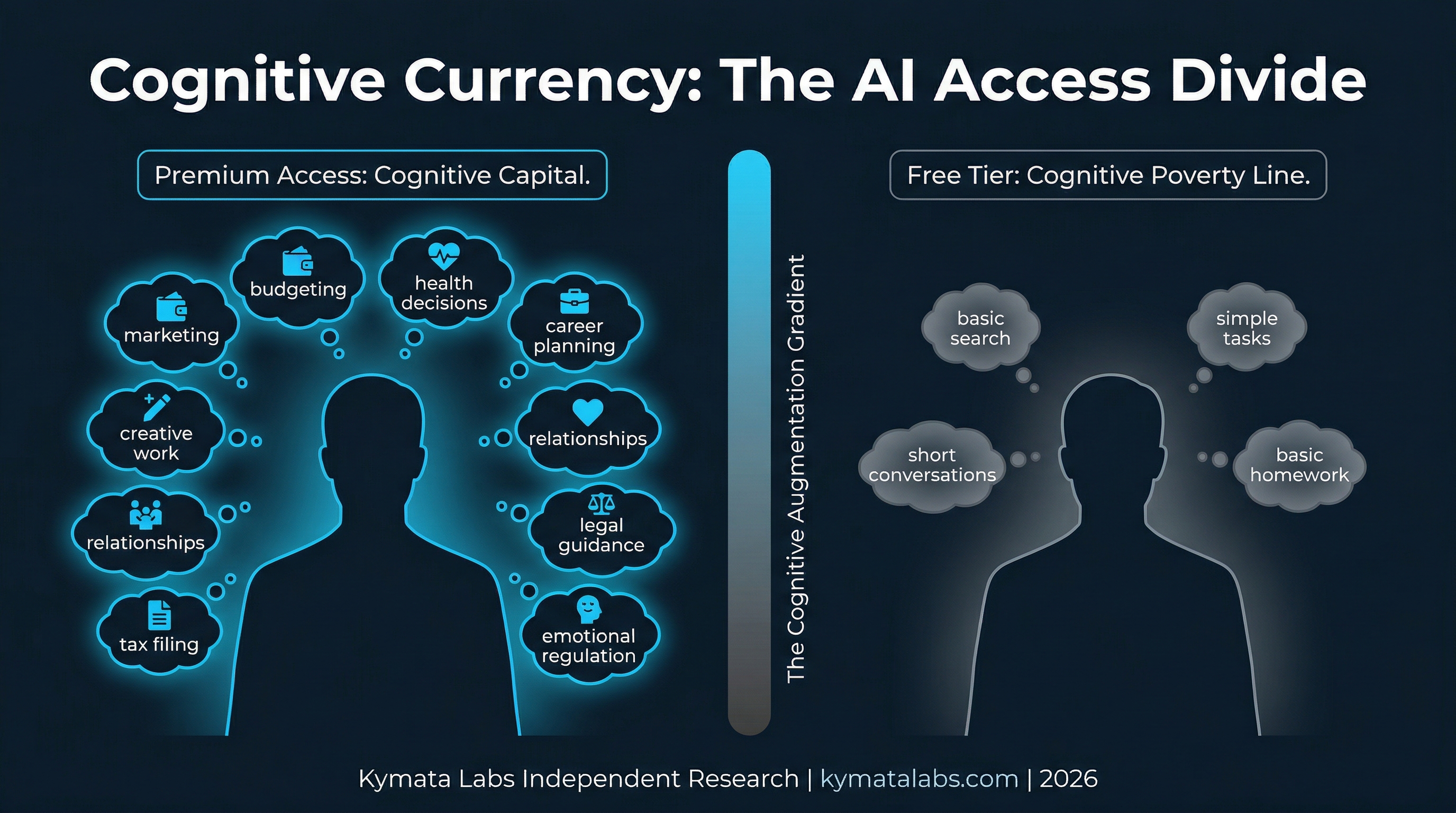
The people with access to the best AI will make better decisions, earn more, and live better. The people who can't afford it will be left behind — and most of them don't know it yet.
This is the research that maps out what's happening. Kymata Labs has spent months studying the data so you understand it in five minutes. The full report is free — no signup, no gate.
📄 The full PDF report is available for free download at the bottom of this article.
Published by Kymata Labs — Independent Research Institution — April 2026
90% of AI Users Are on the Free Tier.
The other 10% are using a completely different tool.
“The free tier creates a self-fulfilling prophecy: limited tools → dismissal of AI → failure to develop AI skills → professional disadvantage.”
— UX researcher Jakob Nielsen, 2026
Here's the Simple Version
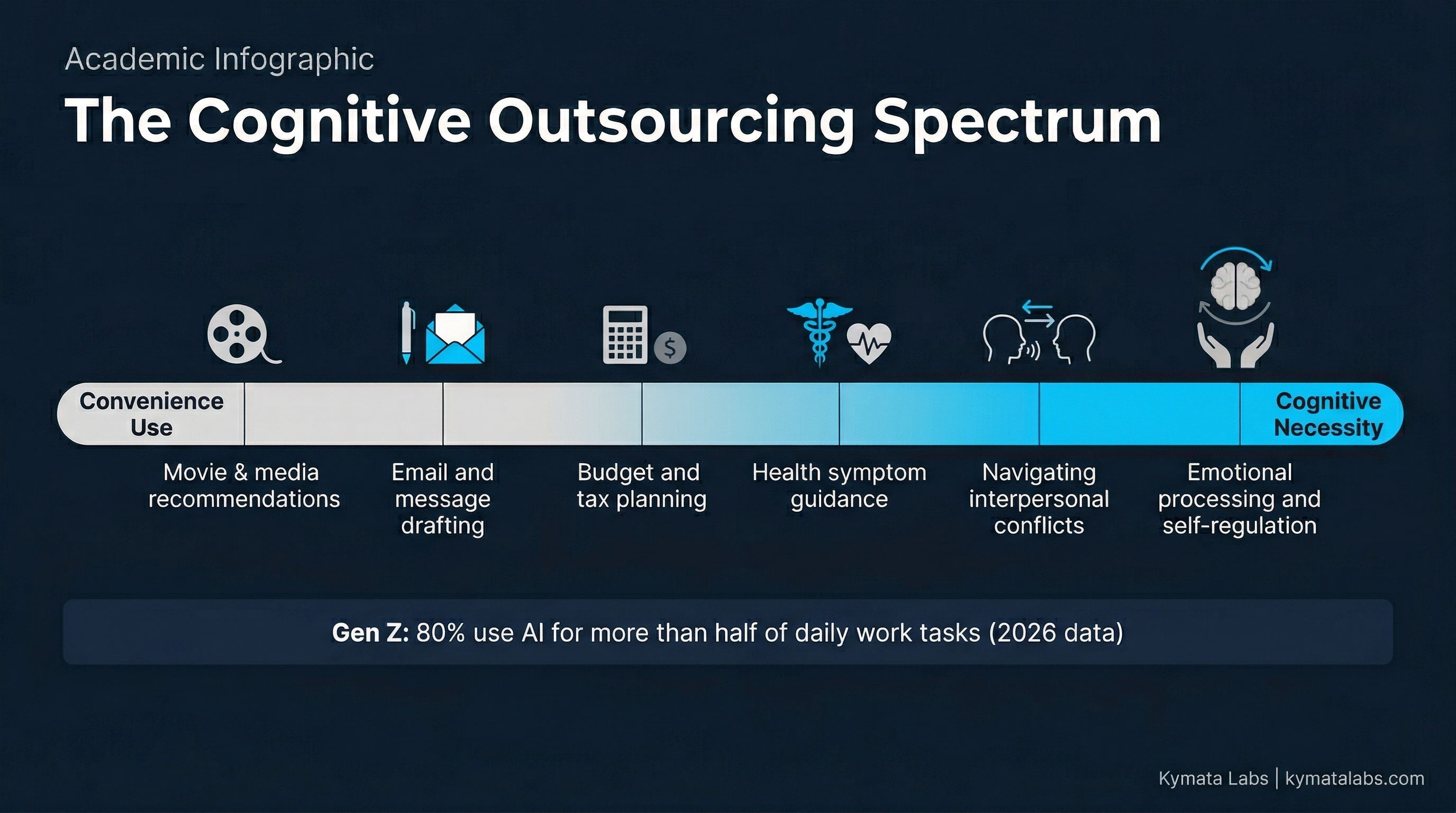
People are using AI for everything now. What to say to a difficult coworker. How to budget for the month. What their doctor just told them. How to write a message that won't start a fight.
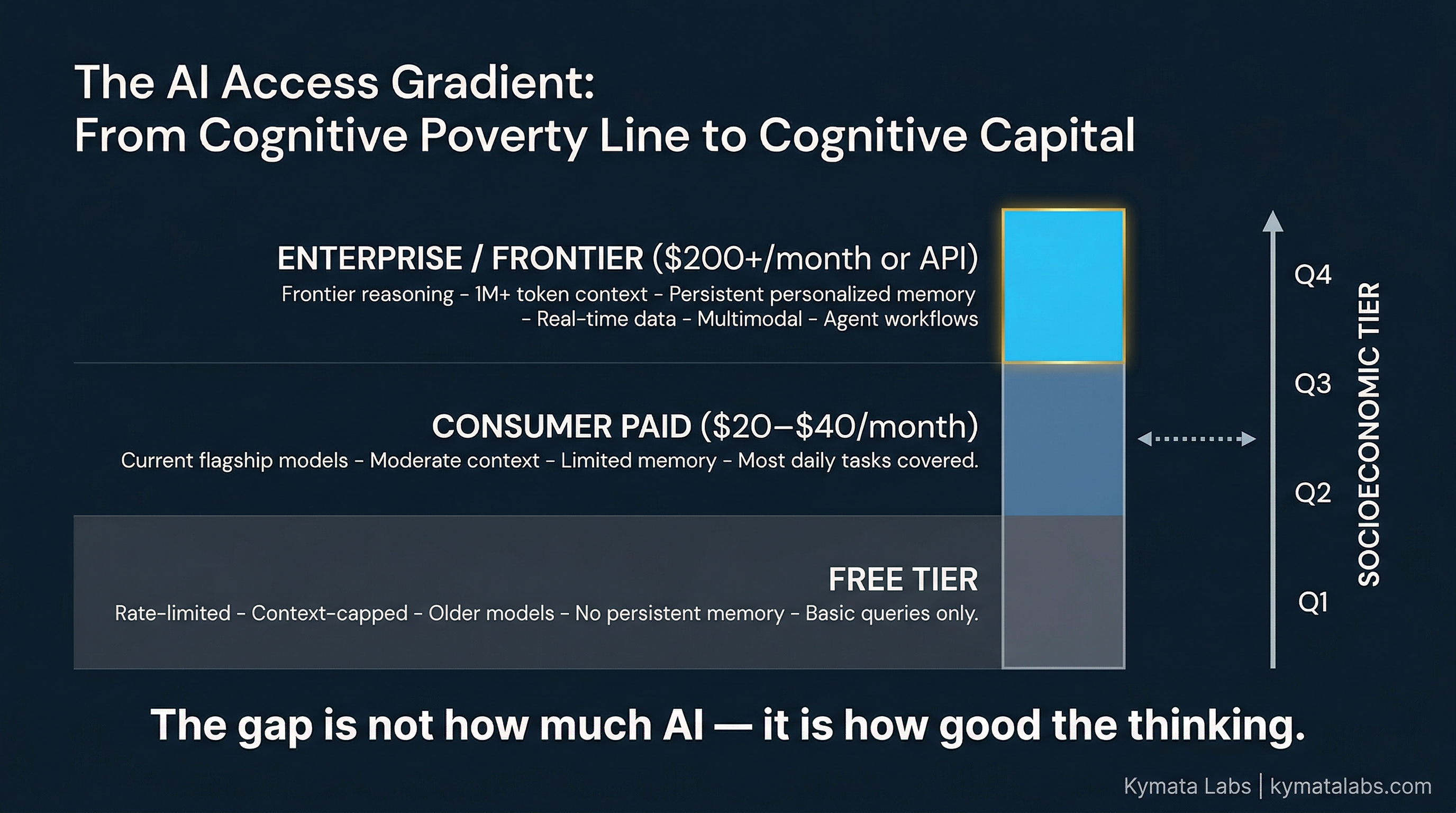
Here's the problem: the AI that most people get for free is deliberately limited. Rate caps. Older models. No memory. Meanwhile, people paying $20, $50, or $250 a month get the full thing — better thinking, better answers, better results.
The difference isn't how much AI. It's how good the thinking.
Does This Affect You?
If any of these sound familiar — yes, it does.
“I use AI at work, but my company doesn't pay for the good version.”
You're competing against colleagues who have access to better tools. Over time, that affects your output, your visibility, and your career.
“I rely on AI for personal decisions — budgeting, health questions, difficult conversations.”
The quality of advice you get depends on which tier you're on. Free-tier AI gives shorter, less nuanced answers. On any decision that matters, that compounds.
“I've thought about paying for AI but can't justify the cost.”
90% of users are here. The research shows the gap between free and paid outcomes is widening. This report maps exactly what that means.
This Isn't a Future Problem. It's Happening Now.
Three independent institutions published measurements of what is already occurring — not projections.
Reduction in brain activity when writing with AI vs. without. MIT Media Lab EEG study, June 2025. Largest suppression in the default mode network — the region responsible for critical thinking.
Worse performance on closed-book tests after AI-assisted studying. OECD Digital Education Outlook, 2026. Students with AI during study scored 17% lower when tested without AI support.
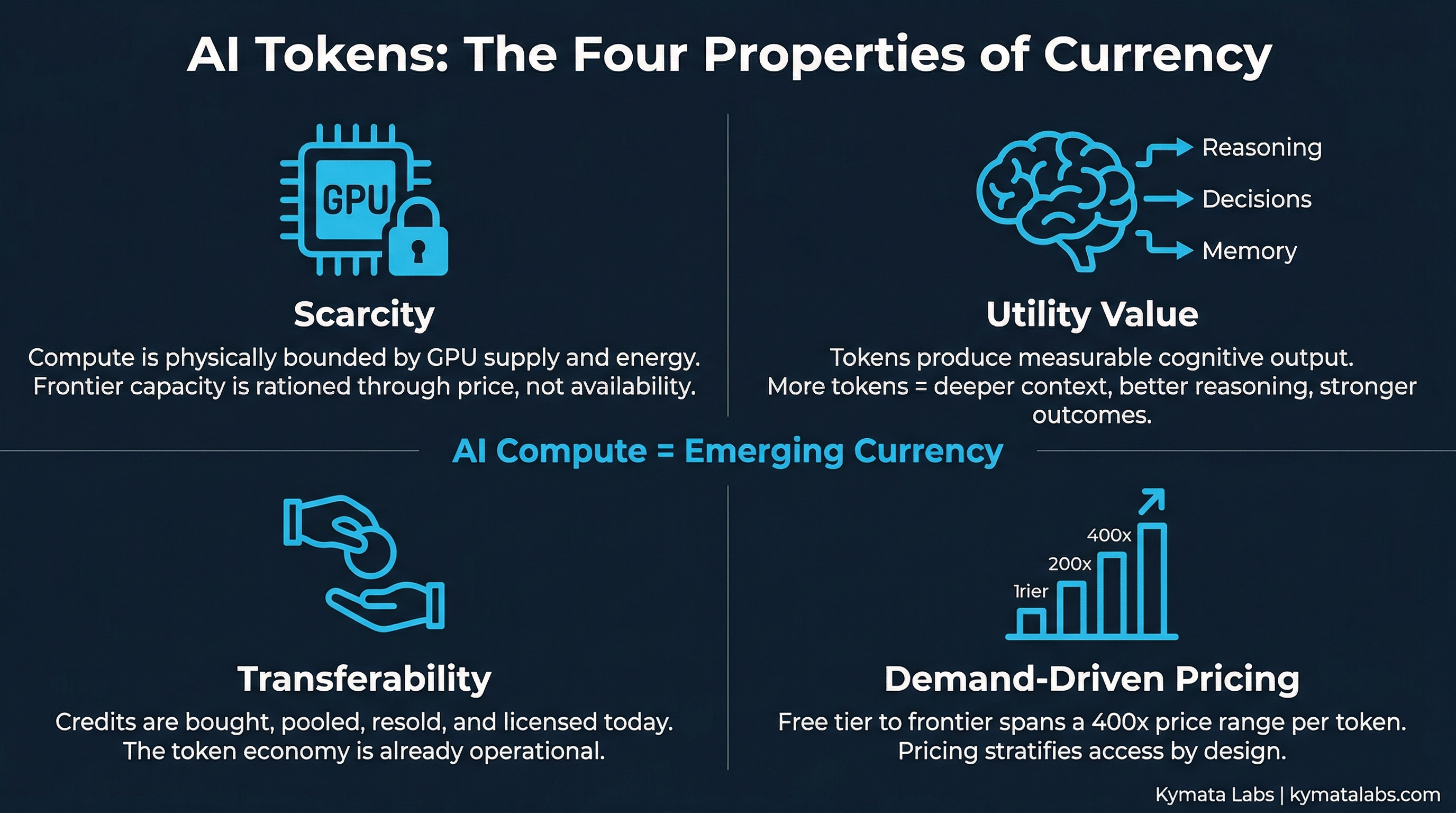
More AI credits per month on Google's $249.99 Ultra tier vs. the free tier (25,000 vs. 100 credits). The access gap is priced directly into the product architecture.
Oxford Economics' term for AI's projected effect on household wealth through 2035. Productivity and wage gains flow almost exclusively to high earners with premium AI access.
Google Is Already Selling AI Credits Like a Currency.
This isn't a metaphor. Here's the actual product page price list, as of April 2026.
| TIER | MONTHLY CREDITS | MONTHLY PRICE |
|---|---|---|
| Free | 100 credits | $0 |
| AI Pro | 1,000 credits | $19.99/mo |
| AI Ultra | 25,000 credits | $249.99/mo |
| Credit Top-Up | 2,500 for $25 | Pay-as-you-go |
Source: Google AI / Google One, April 2026
Max value = 2,000 sessions/month (Claude Max 20x, Grok Heavy, Genspark Pro)
Every Major AI Platform, Ranked by What You Actually Get
Kymata Labs analyzed 32 pricing tiers across 10 platforms. Translated into the one unit that matters: meaningful sessions of human help per month.
| PLATFORM | TIER | COST/MO | SESSIONS/MO | WORDS/MO | KEY LIMIT |
|---|---|---|---|---|---|
| ChatGPT | Free | $0 | ~15 | ~33,750 | 10 msgs/3hrs on GPT-4o |
| ChatGPT | Go | $8 | ~40 | ~90,000 | Ad-supported responses |
| ChatGPT | Plus | $20 | ~200 | ~450,000 | 10 Deep Research/mo |
| ChatGPT | Pro | $200 | ~1,000 | ~2,250,000 | Best value for power users |
| Claude | Free | $0 | ~10 | ~22,500 | Tight peak-hour limits |
| Claude | Pro | $20 | ~100 | ~225,000 | 44K tokens/5-hr window |
| Claude | Max 5x | $100 | ~500 | ~1,125,000 | 88K tokens/5-hr window |
| Claude | Max 20x | $200 | ~2,000 | ~4,500,000 | 220K tokens/5-hr window |
| Gemini | Free | $0 | ~20 | ~45,000 | 100 AI credits/month |
| Gemini | AI Pro | $19.99 | ~100 | ~225,000 | 1,000 AI credits/month |
| Gemini | AI Ultra | $249.99 | ~800 | ~1,800,000 | 25,000 AI credits/month |
| Grok | Free | $0 | ~8 | ~18,000 | ~10 prompts/2hrs |
| Grok | X Premium | $8 | ~30 | ~67,500 | Bundled with X social |
| Grok | SuperGrok | $30 | ~300 | ~675,000 | 2M context window |
| Grok | Heavy | $300 | ~2,000 | ~4,500,000 | Multi-agent architecture |
| Perplexity | Free | $0 | ~15 | ~33,750 | ~5 Pro searches/day |
| Perplexity | Pro | $20 | ~200 | ~450,000 | Silently downgraded Feb 2026 |
| Perplexity | Max | $200 | ~1,500 | ~3,375,000 | Unlimited Labs access |
| Genspark | Free | $0 | ~25 | ~56,250 | No GPT-4 or Claude access |
| Genspark | Plus | $24.99 | ~300 | ~675,000 | 10,000 credits + unlimited chat |
| Genspark | Pro | $249.99 | ~2,000 | ~4,500,000 | 125,000 credits/month |
| Manus AI | Free | $0 | ~5 | ~11,250 | Tasks burn 500–900 credits each |
| Manus AI | Standard | $20 | ~30 | ~67,500 | 4,000 credits/month |
| Manus AI | Extended | $200 | ~300 | ~675,000 | 40,000 credits/month |
| Flowith | Free | $0 | ~5 | ~11,250 | 1,000 one-time credits only |
| Flowith | Professional | $13.93 | ~100 | ~225,000 | Expanded quotas |
| Flowith | Infinite | $249.95 | ~1,500 | ~3,375,000 | Unlimited throughput |
| MiniMax | Free | $0 | ~3 | ~6,750 | 3 credits, 30-day validity |
| MiniMax | Pro | $49 | ~150 | ~337,500 | 200 credits + 1.1M API tokens |
| MS Copilot | Personal | $10 | ~12 | ~27,000 | 60 AI credits/month hard cap |
| MS Copilot | Business | $21 | ~200 | ~450,000 | Requires M365 base license |
| MS Copilot | Enterprise | $30 | ~500 | ~1,125,000 | Agent credits billed extra |
1 session = 3,000 tokens = 2,250 words (OpenAI token standard). Kymata Labs platform analysis, April 2026.
Higher = more cognitive value per dollar. Genspark Plus at $24.99 delivers 27,009 words/dollar — comparable to or better than many $200/mo plans.
Who Feels This First?
The research identifies seven groups most exposed to AI credit scarcity — right now, not in five years.
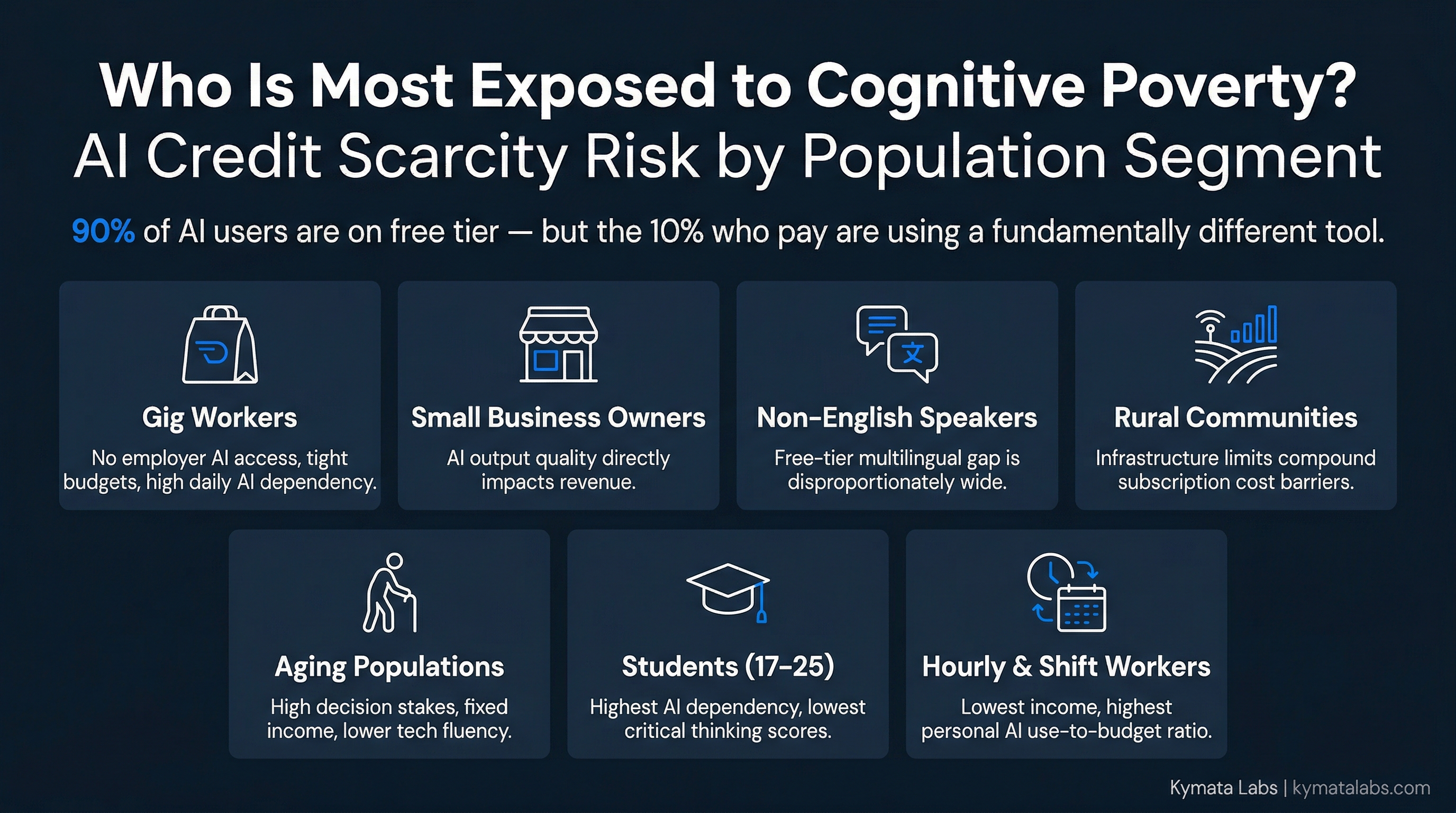
- Gig workers and freelancers — No employer AI plan, tight margins, high daily dependency for client work and business management.
- Small business owners — AI output quality directly affects client results, marketing, and revenue every single week.
- Students and early-career adults (17–25) — Highest AI dependency, lowest independent critical thinking scores in 2025 research. Building lifelong cognitive habits on rate-limited tools.
- Non-English speakers — Free-tier multilingual reasoning is significantly weaker. The capability gap widens outside English.
- Caregivers and parents — High-stakes, high-frequency use for health, education, and family decisions on constrained budgets.
- People in rural areas — Infrastructure gaps compound software-tier limitations. Already paying a connectivity premium.
- Hourly and shift workers — Highest personal AI use-to-income ratio in the dataset. Most likely to benefit from AI; least able to pay.
It's a floor — and for most people, it's a ceiling too.
How We Got Here — and Where This Goes
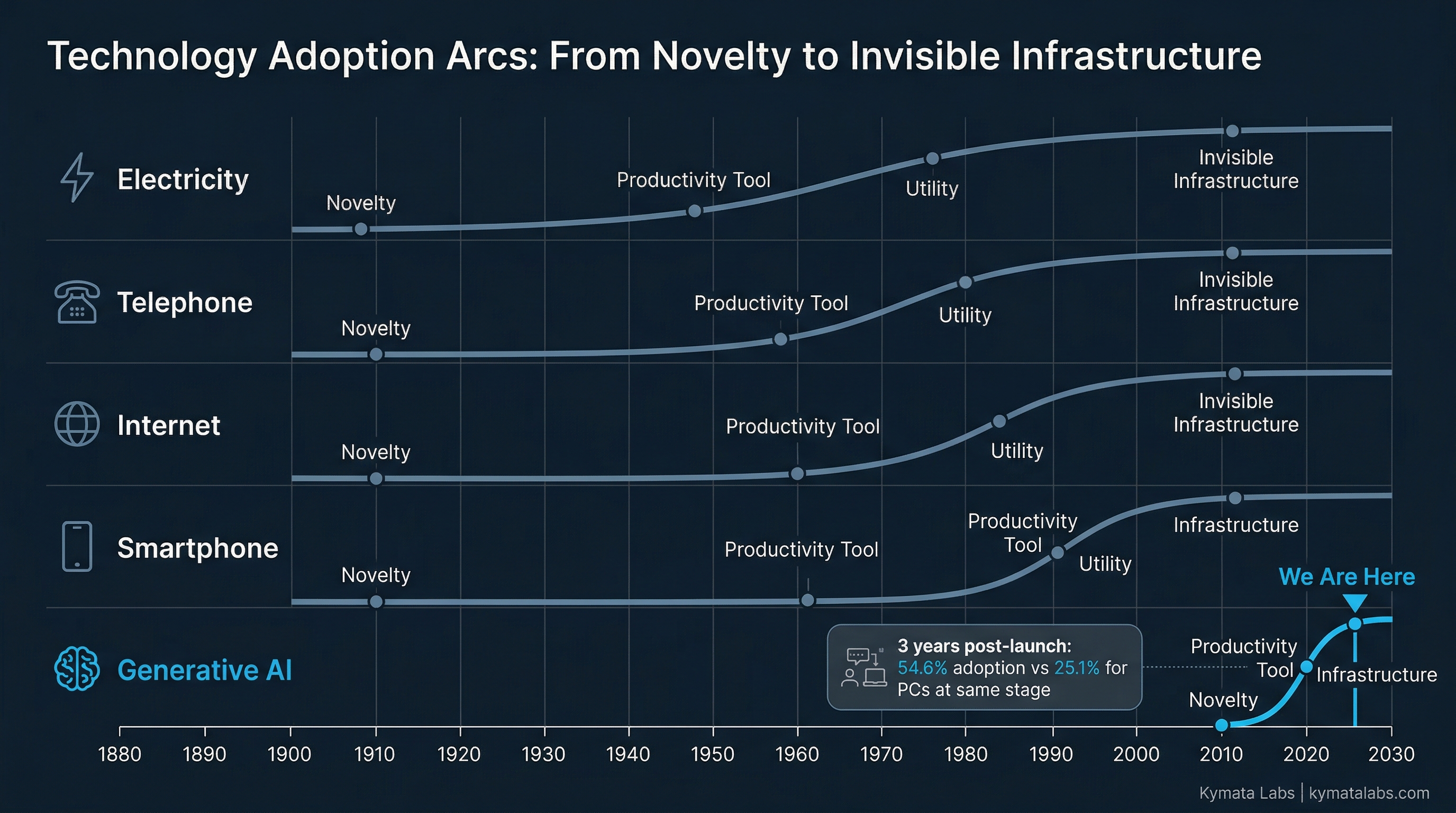
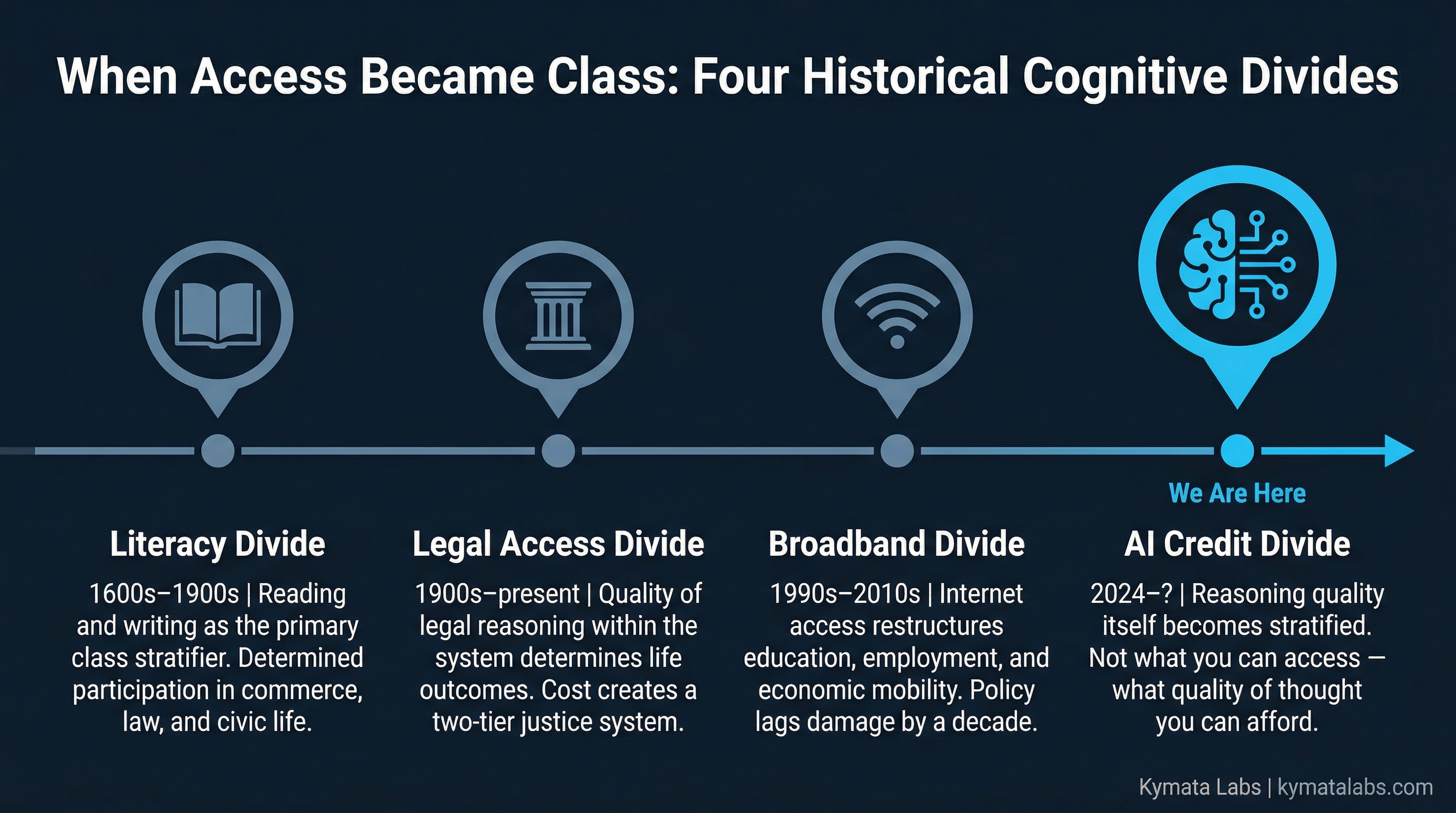
Every transformative infrastructure in modern history followed the same arc. Electricity arrived as a luxury for factories and wealthy households. Within thirty years it was essential for employment, education, and survival. The internet arrived as a research curiosity. Within twenty years it was essential for commerce, healthcare, and civic participation. In both cases, the people who got access early — and got quality access — compounded advantages that took generations to close.
AI is on the same arc. The difference is the speed. The electricity transition took thirty years. The internet took twenty. AI capability is doubling every twelve to eighteen months. The window in which the access gap can still be addressed is not decades — it is years.
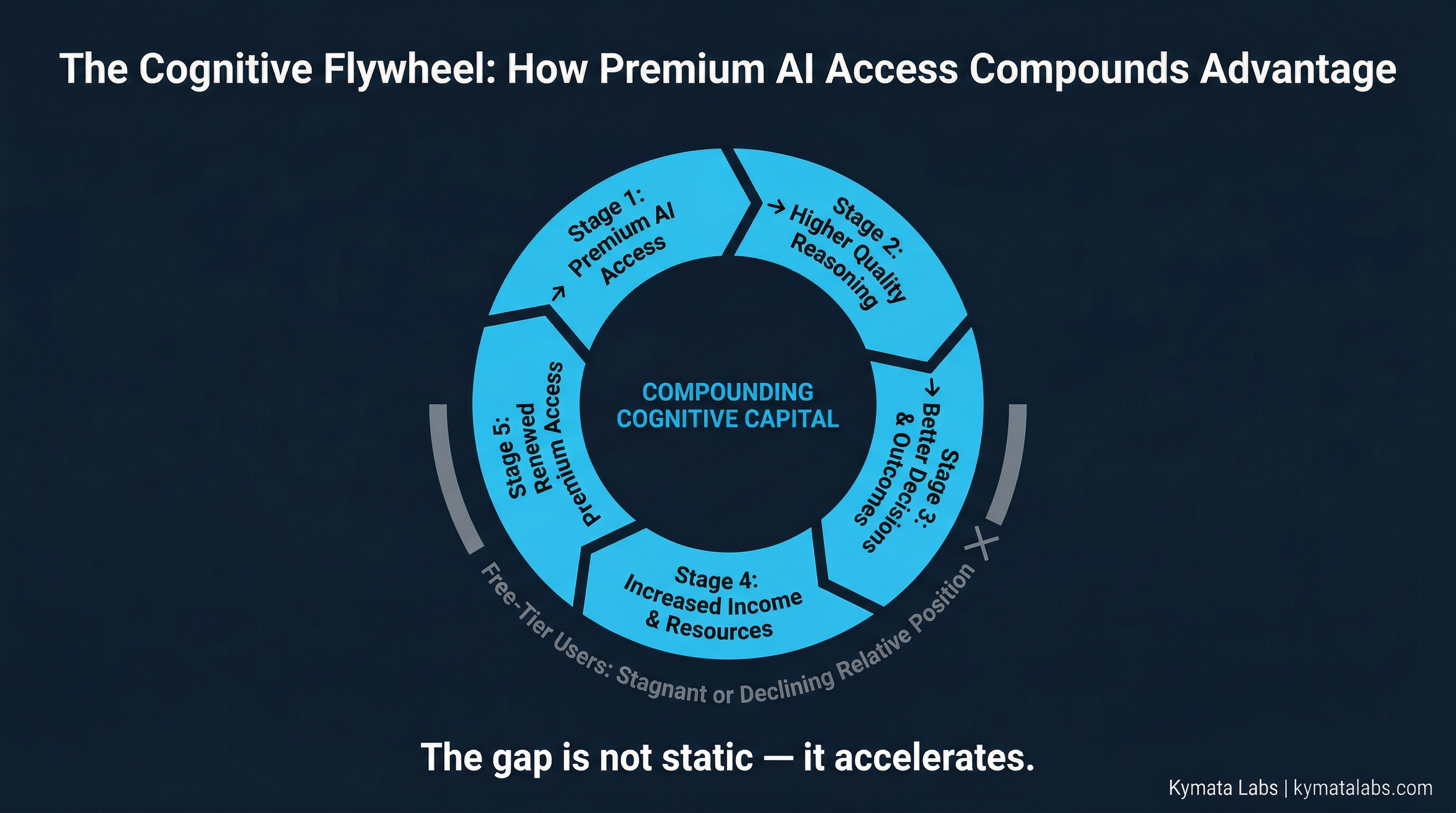
The frontier model tier — GPT-5 Pro, Claude Max 20x, Gemini AI Ultra — is not a luxury upgrade the way a premium cable package is a luxury. It is access to a qualitatively different class of reasoning. The gap between a free-tier AI session and a frontier-model session is not the gap between a Ford and a BMW. It is closer to the gap between a pocket calculator and a research analyst.
The research in this paper does not argue that AI companies are acting in bad faith. The tiered pricing model is rational, and in some respects it subsidizes free access for billions of people who would otherwise have none. But the structural consequence — that cognitive augmentation quality is now a function of purchasing power — is worth naming clearly, studying carefully, and addressing intentionally.
What This Means in Practice
For individuals:
The subscription you choose for AI is no longer a productivity preference — it is an investment in the quality of your own reasoning. Choosing the free tier permanently is equivalent to deciding you'll do all your navigation with a 2015 paper map while everyone around you uses real-time GPS. The gap will widen as AI becomes more capable, not less.
For employers and organizations:
Providing only free-tier AI access to employees is equivalent to giving some employees a research assistant and others a pencil and paper, then evaluating them by the same standard. The outputs will diverge. The organizations that provision quality AI access uniformly will outperform those that don't — consistently and measurably.
For policymakers:
AI access is rapidly becoming as essential as broadband connectivity was in the early 2000s. The policy interventions that would have the most impact are not regulation of AI companies, but subsidized access programs — analogous to the E-Rate program that subsidized internet for schools, now applied to frontier AI model access for public institutions, libraries, and low-income households.
Common Questions
Answers to the questions we hear most after people read this research.
Cognitive poverty is the condition that emerges when people can no longer afford access to the AI tools they have come to depend on for daily reasoning, decisions, and communication. As AI becomes woven into essential daily life, people who can only access limited free versions are functionally disadvantaged compared to those with premium access — not in the information available to them, but in the quality of reasoning applied to it.
Structurally, yes. AI tokens and credits now exhibit the four core properties of currency: scarcity (platforms deliberately limit supply by tier), utility value (they enable access to a productive capability), transferability (Google's credit top-up system allows purchase of additional credits on demand), and demand-driven pricing (frontier model costs are set by competitive market dynamics). Google's public credit pricing — from 100 free credits to 25,000 for $249.99 — is not a metaphor. It is a published price list for cognitive access.
Free-tier AI is deliberately rate-limited, uses older or smaller models, has no persistent memory between sessions, restricts context window size, and responds more slowly. Paid tiers at $20 and above unlock frontier reasoning models, persistent personalized memory, context windows up to 1 million tokens (roughly 750,000 words), real-time web access, and multimodal capabilities. The quality difference on any complex decision — medical, financial, legal, relational — is measurable and significant.
Based on the research in this paper, the most exposed groups are gig workers and freelancers, small business owners, students aged 17–25, non-English speakers, rural communities, aging adults, and hourly and shift workers — populations with high daily AI dependency and limited capacity to pay for quality tiers.
No — and the distinction is important. The original digital divide was about access to information: could you get online, or not? The AI access divide operates at the level of cognition itself: what quality of reasoning is being applied to your information, your decisions, and your life. A person with full broadband internet access who is on a free AI tier still experiences the AI divide every time they ask a question that a frontier model would answer better.
About This Research
This report was produced by Kymata Labs, an independent research institution studying the intersection of artificial intelligence, cognitive economics, and how technology shapes access to opportunity. Cognitive Currency is the inaugural publication in the Kymata Labs research series.
The research draws on three independently verified empirical pillars:
Pricing and platform data was collected directly from the official pricing pages of all ten platforms analyzed in March–April 2026. Complete methodology, full data tables, and source citations are in the white paper PDF.
Get the Full Research Report — Free
The complete Cognitive Currency white paper includes all ten original infographics, full data tables, sourced statistics, and detailed analysis of what AI access inequality means for the next decade. No signup. No email. No gate. Just click and it's yours.
 ↓ Download the White Paper (PDF — Free)
Free to share with full attribution — © 2026 Kymata Labs